




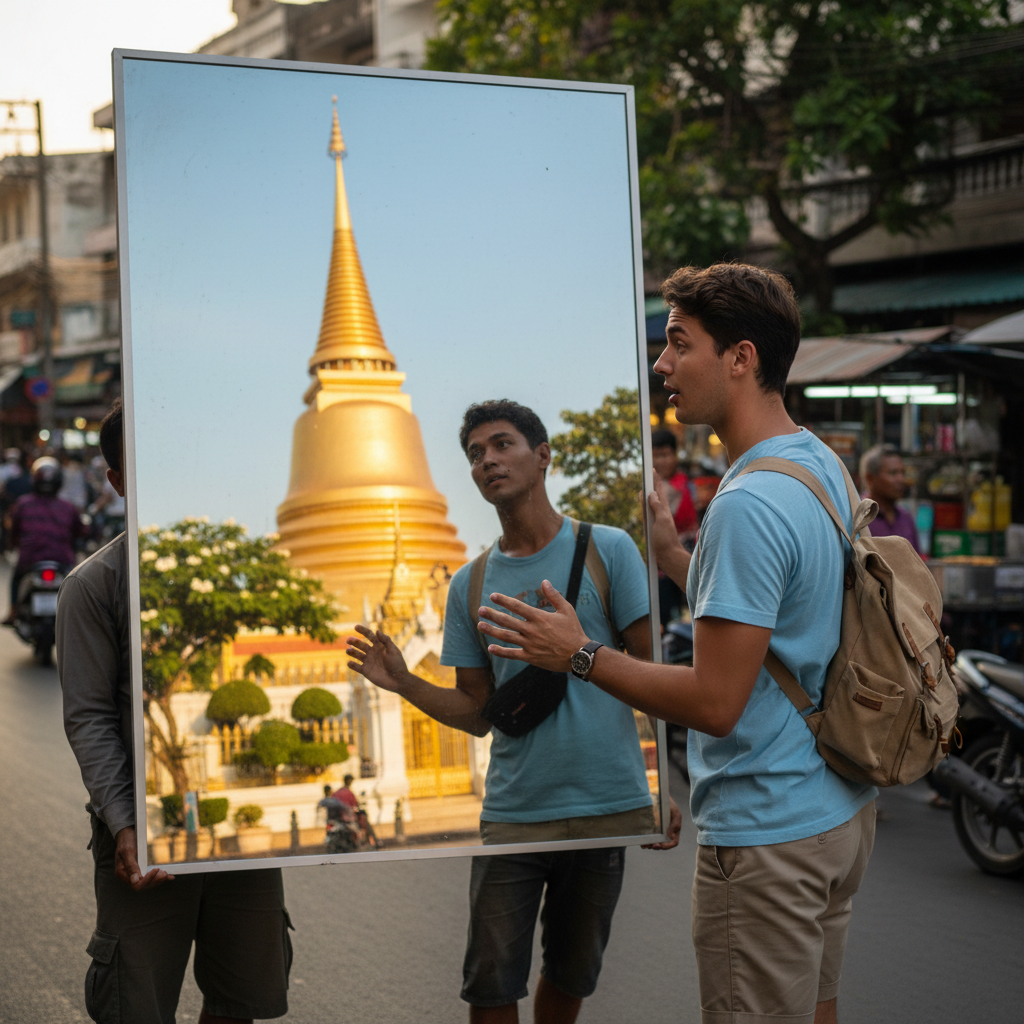
How is a temple tour of Phuket fundamentally different from an independent visit?
Going to a temple on your own often comes down to contemplating the facades and trying to guess the meaning of what you see. Professional tour of Phuket temples transforms this experience from visual to semantic. The key difference is the presence of an expert guide who acts as a translator between your perception and the complex world Thai Buddhism.
A guide doesn't just show the way. It provides access to areas where it is not customary for an independent tourist to enter or it is not clear how, for example, inside the bot (the main prayer hall) at the appropriate moment. He deciphers the symbols: why this Buddha has such a pose (mudra), what the demons at the entrance mean, why multi-colored pieces of porcelain are needed on the stupas. It contextualizes: connects the architecture with the history of the island, local legends, modern religious practices. And, crucially, the guide gently guides in matters of etiquette, preventing involuntary violations that could offend the feelings of believers.
The value of a guide is not in the kilometers of travel, but in the depth of interpretation that turns golden stupas and statues into living pages of culture.
Which route should you choose - a sightseeing tour of the main shrines or a deep dive into one or two temples?
The choice depends on your goals and temperament. Both formats have a right to exist, but they solve different problems.
Sightseeing tour (usually includes Wat Chalong, Big Buddha, possibly Wat Phra Nang Sang) is “acquaintance”. It is ideal for those who are short on time or who want a first, panoramic view of Phuket's religious architecture. Such a route gives a breadth of coverage and allows you to compare the styles and atmosphere of different complexes. However, depth may be lost behind quantity: time at each object is limited, and information is presented more concisely.
Deep dive into 1-2 locations — an immersive experience. It suits thoughtful travellers willing to spend several hours exploring the details of a single complex. There is time to sit quietly, observe monastery life, examine the symbolism of every building and perhaps speak to a monk. This turns a visit from an excursion into a meditative experience, but requires the guide to have exceptional knowledge of this particular place.
What should you look for in the architecture and decoration of a temple in order to see more than just decor?
The temple is a complex text written in a symbolic language. Here are the keys to reading it:
Buddha poses (mudras): Buddha touching the ground (Maravijaya) symbolizes victory over temptation. Buddha in a meditation pose is a state of deep meditation. The ability to “read” the mudra will tell you what aspect of the teaching the statue is dedicated to.
Mythical Guardians: Nagas (snakes) at the stairs are protectors of teaching and a symbol of wisdom. Kinnars (half-bird, half-human) represent devotion. The yaks (demons) at the gate to the bot are not evil, but powerful guardians who drive away evil forces.
Architectural elements: The chedi (stupa) houses relics and symbolizes the enlightened mind of the Buddha. Bot is the most sacred place where monastic ordination ceremonies are held. Pay attention to the multi-tiered roofs: their number indicates the status of the temple.
Colors: Gold is a symbol of enlightenment and purity of the Buddha's teachings. The abundance of colorful glass and porcelain is not just decoration, but a reflection of the Buddhist idea of the radiant, precious nature of reality.
What are the unobvious rules of behavior and dress code that are not written about in guidebooks?
Besides the obvious rule of covering your shoulders and knees (this applies to both men and women), there is a subtle etiquette, the knowledge of which shows deep respect.
Before entering the bot: Remove shoes and hats. You can enter only if there is no ceremony going on inside (the guide will tell you). Upon entering, sit on the floor in a cross-legged or tucked-legs position (with your feet pointing away from the main Buddha statue). Do not point your feet at the Buddha statue or turn your back to it.
Interacting with Monks: Women are forbidden to touch the monks and hand anything directly into their hands. The object is placed on a cloth or on a bench, from where the monk will take it. The nun, on the contrary, is given things directly into her hands. When speaking, it is customary to bow your head slightly.
General behavior: Avoid loud talking and laughter in prayer areas. Don't hug or show affection in public. When photographing people (especially monks), always first ask for non-verbal permission - with a smile and a gesture.
Is it true that temple complexes like Wat Chalong are too touristy and have lost their authenticity?
This is a common misconception. Places like Wat Chalong — living, vibrant places where mass tourism exists alongside a deep religious life. Yes, there are many visitors and souvenir stalls. At the same time, local people make offerings, pray and hold important family ceremonies, such as ordination as a monk.
The task of a conscious tourist is not to ignore this place as “not real”, but to learn to see the authentic practice behind the tourist façade. Get away from the central pagodas: go to the less frequented prayer halls, watch the Thais circumambulate the chedi with incense and lotuses, listen to the sounds of mantras. Authenticity here does not lie in the absence of tourists, but in the ability to see a continuous spiritual tradition into which outside visitors are woven.
How to integrate rituals such as offerings to monks or releasing birds into an excursion, so that it does not become profanity?
Participation in rituals can be a culmination cultural excursion, if you approach them consciously. The main rule: your action should be motivated by respect and interest, and not by the desire to take a spectacular photo.
Morning offering to the monks (Sai Bat): If your tour starts early in the morning, you can take part in it. Buy simple food (rice, canned food, sweets) at the market. During the ceremony, maintain reverent silence, and for women, keep a distance. The point is not in “feeding,” but in the act of giving (danna), which allows laymen to accumulate merit, and monks to receive food.
Release of birds/fish: The original meaning is an act of compassion, the liberation of life. Today this practice has become commercial. If you decide to participate, do it not just for show, but with inner intention. Recognize the symbolic gesture of liberation. It is better to choose a small, local seller rather than a large tourist outlet.
Conscious participation begins with the question “why am I doing this?” If the answer is “to understand” or “to show respect,” you are on the right track.
Should lesser-known temples be included in the program, and which of them have the greatest cultural value?
It's definitely worth it. The little-visited temples offer a uniquely tranquil atmosphere and often house amazing historical artifacts.
Wat Phra Nang Sang in Thalang - one of the oldest on the island. Its main value is three huge ancient Buddha statues, cast from pure tin, silver and gold. There are almost no tourists here, the atmosphere of true antiquity reigns.
Wat Sirey in Sirey - known for its Burmese-style architecture, unusual for Phuket, and a stunning collection of Buddha statues in different styles from across the region.
Wat Suwan Khiri in Rawai - a cave temple, where shrines are located in natural grottoes. This is a place of power with a special, mystical mood.
Including such points in the route requires the guide to have in-depth knowledge and flexibility in logistics. They are often located away from main roads. But they are the ones that make it possible to paint a multifaceted picture of the religious life of Phuket that goes beyond the ceremonial postcards.
Is a tour of the Phuket temples an investment in impressions or an overpayment for transport?
The answer depends solely on the quality of the service. A bad excursion is really overpaying for a taxi between points. A good one is an investment, the dividends of which are not photographs, but understanding.
Quality criteria excursions to Phuket temples:
- Guide competencies: His ability to answer complex questions about philosophy, history and art, rather than simply reciting memorized text.
- Content Depth: Emphasis on interpretation rather than listing facts. The ability to connect the past with the present.
- Sensitivity to the group: The ability to adapt a story to the interests of the audience, maintaining a balance between information and personal space for contemplation.
- Final Conversion: After such an excursion, you leave not with the feeling “I saw everything,” but with the feeling “I began to understand something.” You do not receive a list of attractions, but a key to culture, which you can use on your further journey through Thailand.
So the value lies in transforming your perception. You pay not for moving between golden roofs, but for the opportunity to see behind them a whole universe of meanings that will forever change your idea of Thai Buddhism and the island of Phuket itself.