




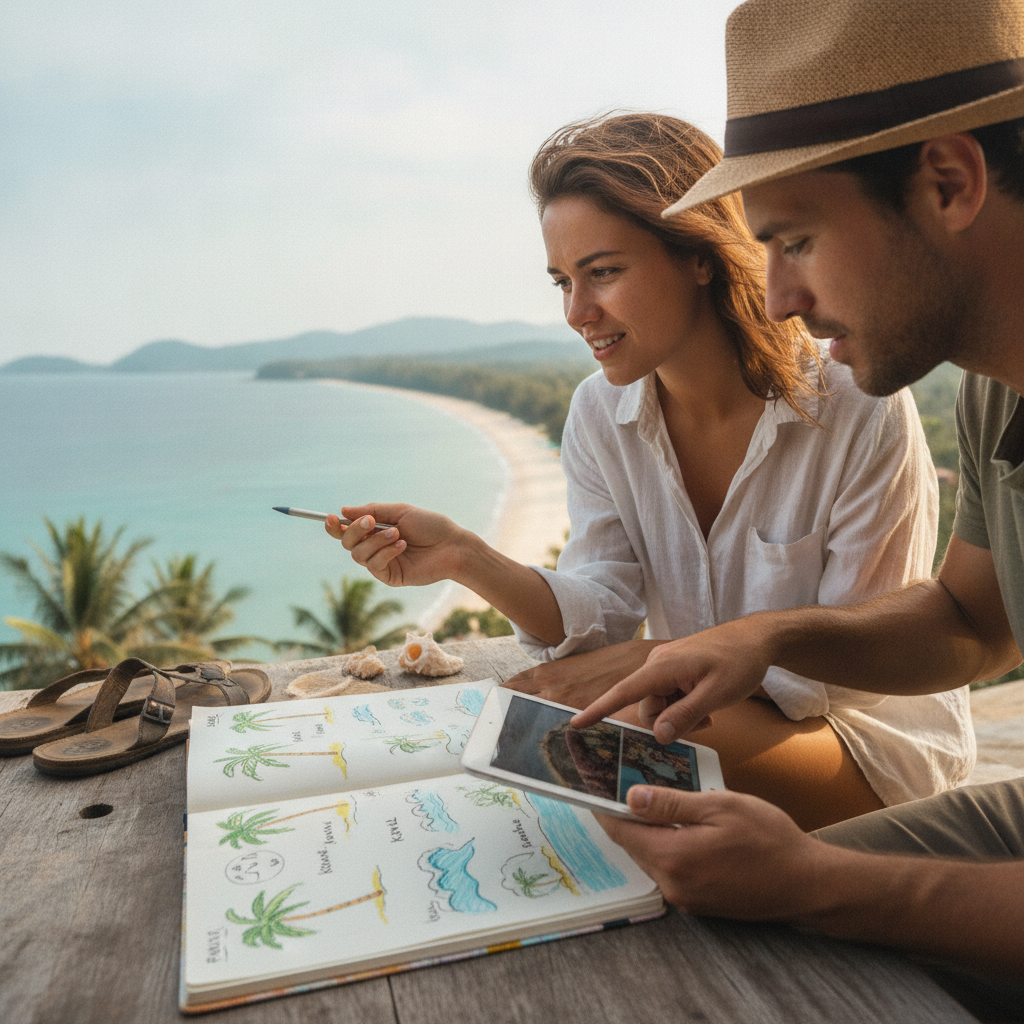
Is it worth going to the beaches of Phuket with an organized excursion or is it better to go on your own?
The main question that faces everyone who plans excursion to the beaches of Phuket: Pay a travel agency or rent a bike and go yourself? There is no clear answer, but there are clear selection criteria.
Independent route gives you complete freedom: you decide how long to stay on Karon or turn onto the forgotten road to Nai Harn. The downside is navigation, finding parking and the risk of getting stuck in traffic. Cost: bike rental (250–400 baht per day) plus gasoline (about 200 baht per day).
Group excursion relieves logistical headaches, but is tightly tied to schedules. You will see 3-4 beaches in a day, but you will stay on each one exactly as long as the guide decides. Price - from 1500 baht per person. For the first acquaintance with the island, this is justified: you will get a general picture, and next time you will go to specific points.
If your goal is to find “your” beach for relaxation, and not just take a dozen photos, choose an independent route. If you want to see as much as possible in a day without extra effort, take a tour.
A compromise option is a private transfer with a driver for half a day. It's more expensive (around 2,500-3,000 baht per car) but gives flexibility without having to turn the steering wheel in unfamiliar left-hand traffic.
Which Phuket beaches should you include in your itinerary if you only have one day?
One day is not a sentence. A realistic route covers the west coast from south to north, but without fanaticism. Optimal scheme: 3–4 beaches with different atmospheres.
Morning start (9:00–10:00) – Kata Noi or Kata Yai. It's quiet, the water is calmer than in the north, and there are few people early in the day. Ideal for a swim without the crowds. There is parking, sun loungers - 100-150 baht.
Transfer (11:00–12:00) – Karon. Main beach for families: long line of sand, gentle entrance, moderate waves. You can stroll along the embankment and have a snack in one of the cafes. Please note that during the rainy season there are strong waves and red flags.
Lunch and shopping (12:30–14:30) - Patong. Even if you don't like parties, you shouldn't skip Patong on your itinerary. This is a contrast: noise, bars, hundreds of tourists. Stay for 40 minutes to see Bangla Road and appreciate the scale. It is not necessary to swim here - the water is not the cleanest.
Final (15:00–16:30) - Kamala or Surin. Quieter beaches with good infrastructure. Kamala is suitable for a relaxed end to the day: there is soft sand, no harsh waves, and many family restaurants.
This route along the beaches of Phuket will cover 90% of requests: you will see both the noisy center and calm bays, and you will understand where you want to return.
Which Phuket beach is best for families with children, and which one is best for partygoers?
The division of beaches by type of recreation is not marketing, but a reality dictated by geography and infrastructure. Here is an objective picture.
| Beach | Type of holiday | Waves | Infrastructure | Prices (bed + lunch) |
|---|---|---|---|---|
| Patong | Parties, shopping, noise | Medium, strong in season | Maximum: bars, clubs, cafes | High (300+ baht) |
| Karon | Family, calm | Moderate, gentle entrance | Good: cafe, toilets, parking | Medium (200–250 baht) |
| Kata Noi | Family, secluded | Weak, clean entry | Average: several cafes, sun loungers | Medium (150–200 baht) |
| Kamala | Family, relaxed | Weak, safe | Good: market, cafes, hotels | Low (100–150 baht) |
| Nai Harn | Calm, local | Weak, clear water | Medium: cafe, parking | Medium (150–200 baht) |
| Mai Khao | Wild, solitary | Strong, dangerous for swimming | Minimum: no cafe, no sun loungers | Low (free) |
For families with children definitely choose Karon, Kata Noi or Kamala. There is a gentle entrance, there are no sharp changes in depth, and the waves rarely rise above the knee. During the rainy season (May–October) it is better to move south: Nai Harn and Kata Noi remain calm even during the monsoon.
For party lovers Patong is the only option where the traffic doesn’t stop until the morning. If you want something in between (parties, but not 24/7), pay attention to Karon: there are bars and live music, but you can sleep without earplugs.
Is it true that there is a problem with waves and jellyfish on Phuket beaches?
Yes, this is not a myth, but the problem is localized by season and specific beaches. Let's sort it out without panic.
Waves. From November to April (high season) the Andaman Sea is calm. At this time, you can swim on any beach without risk. From May to October (monsoon season), the west coast of Phuket receives monsoon waves. The beaches of the northern part especially suffer: Mai Kao, Nai Yang, Surin. There the waves can reach 2–3 meters and swimming is prohibited (red flags). The southern beaches - Kata, Nai Harn, Rawai - remain more protected due to the relief.
Jellyfish. Jellyfish season is from July to October. The most dangerous are box jellyfish, but sightings of them are rare in Phuket. More often you come across siphonophores (physalia), the burns of which are painful but not fatal. After a storm, the number of jellyfish increases. Tip: before swimming, look at the flags and ask the lifeguards. If there are protective nets on the beach (for example, on Karon and Kata), the risk is reduced to zero.
The main rule: do not swim on the northern beaches during the rainy season and always pay attention to the color of the flags. Green - safe, yellow - caution, red - swimming is prohibited.
Where are the cleanest beaches and best infrastructure in Phuket?
The purity of water and sand in Phuket varies greatly. If we discard the ratings from guidebooks and rely on real reviews from tourists, the picture will be like this.
The cleanest beaches:
- Nai Harn - southern part of the island. The water is clear, the sand is white, there are no stones. Minus: on weekends there are a lot of locals, but on weekday mornings it’s almost deserted.
- Kata Noi - a small bay with clean water. The bottom is sandy, without sharp corals. Ideal for snorkeling around the edges of the rocks.
- Mai Khao - wild beach in the north. The water is clean, but swimming is dangerous due to the waves. Suitable for walking and photography.
Best infrastructure:
- Patong — there is everything here: from toilets and showers to nightclubs and massage parlors. Sun loungers - 200 baht, umbrellas - free. The downside is that it’s a bit dirty due to the influx of people.
- Karon — good balance: clean, there is a cafe, parking, toilets. Sunbeds - 100–150 baht. In the evening there is an embankment with food courts.
- Kamala — the infrastructure is more modest, but enough for a family holiday: several restaurants, a store, a pharmacy. Sunbeds - 100 baht.
If cleanliness is important to you, choose the southern beaches. If you need comfort and accessibility - Karon or Patong.
Should the beaches on the neighboring islands (Ratcha, Hei) be included in the excursion?
A question that often arises when planning routes along the beaches of Phuket: limit yourself to an island or add travel to neighboring islands? The answer depends on what you are looking for.
Racha Island — a 30–40-minute speedboat journey from Chalong Pier in the south. The beaches really are whiter and the water clearer than in Phuket. The sand is fine as flour, and the water entry is gentle. Facilities are minimal: a couple of restaurants and sun loungers. It is ideal if you want to spend half a day snorkelling at an almost deserted beach.
Hei Island / Coral Island - even closer, 15–20 minutes from Phuket. There are two beaches: one with sun loungers and a cafe, the second is wild. The water is clean, but there are fewer corals than on Ratcha. Suitable for families with children: no waves, shallow.
When to go:
- If you have already been to the main beaches of Phuket and want new experiences.
- If your main goal is snorkeling and clear water.
- If you are ready to spend half a day on the road (boat + transfer).
When not to:
- If you only have 1-2 days in Phuket, it is better to focus on the island itself.
- If you don't like boat trips (the seas can be strong).
- If your budget is limited: a trip to Ratcha will cost 1,500–2,500 baht per person.
It makes sense to include these islands in your Phuket beach tour if you want variety. But don’t replace the main beaches with them - rather, add them as a bonus day.
How to save on excursions to the beaches of Phuket without losing quality?
Saving on excursions is not about cheap tours with dubious transport, but about proper planning. Here are the working methods.
1. Choose your time. High season (November–April) is the peak price. If you come in May or September, the cost of excursions drops by 20–30%, and the beaches are less crowded. The weather during these months is still suitable for swimming, although rain is possible.
2. Bargain on the spot. Prices in street agencies in Patong or Karon are not final. A 10–15% discount is the norm. Don’t take the first excursion you come across, go around 3-4 points.
3. Rent a bike for a few days. If you plan to see 3-4 beaches, renting a bike for 2-3 days will cost less than two group excursions. Plus, you choose the route yourself.
4. Use Grab or Bolt instead of taxis. Taxis in Phuket are expensive (from 300 baht for 5 km). Car ordering apps (Grab, Bolt, InDrive) are often 30–50% cheaper. Especially if you are traveling with two or three.
5. Take food with you. On the beaches, prices in cafes are overpriced. Buy fruit, water and snacks at 7-Eleven or the market - this will save 200-300 baht per lunch.
6. Team up with other tourists. A private transfer for 4-6 people costs about the same as 2-3 seats on a group excursion. Find travel companions in chat rooms or at the hotel reception.
Main advice: don’t chase the number of beaches in one day. It’s better to watch 3 qualitatively than 5 at a gallop. The quality of the experience is more important than checking boxes on a list.
Choosing a beach in Phuket is not a lottery, but a conscious decision based on your priorities. You already know where to look for clean water, where it’s safe to swim with children, and where to party until the morning. Now all that’s left to do is take a map, choose a route and head towards the Andaman Sea. The best beaches in Phuket — those that suit you personally, rather than those on the cover of a glossy magazine.