




You stand on the top of Nakakerd Hill, a panorama of the entire southern Phuket opens up in front of you, and behind you rises 45 meters of snow-white marble - the statue of the Big Buddha. You take a selfie, check the “visited” box and... feel a little disappointed. “Well, a statue and a statue. The view is beautiful." Many people think so. But they miss the main thing - the history that turned this place from a humble idea into the heart of the island. Evolution from a shrine for pilgrims to a must-see point for millions. Understanding this history is key to making your visit more than just a photo, but a profound experience.
The idea on the top of the hill: how the idea for the main symbol was born
In the late 1990s, Phuket was rapidly turning into a world resort mecca. But locals and spiritual leaders felt the island, which has experienced a tourism boom, was missing its spiritual heart, a unifying symbol. This is how the idea was born - to create a Buddha statue that would be visible from many points on the island, reminiscent of harmony and peace. The location was not chosen by chance: Nakakerd Hill, one of the highest points in Phuket, was considered sacred long before this. The Phra Puttaming Ming Mongkol (Great Buddha of Blessing) project was originally conceived not as a tourist attraction, but as a gift to the island, a place for quiet prayer and reflection. Construction began in 2004 with the laying of the foundation and a modest chapel.
Construction that lasts for years: public funding and challenges
This is where the most human part of the story begins. Big Buddha statues in Phuket. The project did not have a multimillion-dollar state budget. It was built literally by the whole world. Funding came from donations - from large contributions from businessmen to modest 100 baht from local residents and tourists. Anyone could buy a small marble tile, which later became part of the cladding. The construction faced difficulties: complex logistics of delivering materials to the summit, weather conditions, and a constant need for funds. It was this stage - “people's construction” - that gave the place a special energy. This is not a cold monument, but a common cause in which the soul of the entire island has been invested.
The Big Buddha has become not just a landmark, but a social project, a symbol of the unity of the local community in an era of change.
Discovery and the first pilgrims: what the first guests saw
Although there was no official “opening day” in the Western sense (construction is still ongoing), by the mid-2000s the complex became accessible to the public. The first guests were almost exclusively Thai Buddhist pilgrims. They came here for prayer, offerings and meditation. The complex was then ascetic: the statue itself was in the woods, temporary pavilions, and a dirt road. There were no souvenir shops or crowds of tour groups. The atmosphere was deeply spiritual and intimate. For those first visitors monument in Phuket was primarily a shrine, not a photo point.
Tourist boom: when Buddha got into all the guidebooks
The turning point came when impressive photographs of the statue under construction began to circulate on the Internet and in guidebooks. Tour operators quickly included the point in standard sightseeing tours excursions around Phuket. The infrastructure began to adapt to the flow: the road was paved, parking lots appeared, the first souvenir shops and cafes appeared. From a place of quiet pilgrimage Big Buddha was rapidly turning into the main secular attraction of the island. This created the first conflict: between the atmosphere of a sacred place and the noise of crowds of tourists in shorts and flip-flops. But it was this boom that finally secured the status of a symbol for the statue, without which a trip to Phuket is considered incomplete.
Modern landscape: what excursions to the Big Buddha have become today
Today, the visitation market has evolved into distinct formats, each of which provides a different experience. The choice depends on what you're looking for: a tick on the list or an immersive experience.
| Visit format | What is this | Pros | Cons |
|---|---|---|---|
| Group excursion | Standard minivan tour in a group of 10-15 people, often combined with Chalong Temple, observation deck and beach. | Inexpensive, everything is organized, transport, a guide is often included. | Strict timing (30-40 minutes on site), general route, superficial information, intrusive delivery to stores is possible. |
| Private tour with guide | Ride in a private car with a personal guide. | Flexible schedule, deep story about history and culture, opportunity to ask questions, visit at a convenient time. | Significantly more expensive than a group tour. |
| Independent visit | Rent a bike or taxi, get up on your own. | Complete freedom, you can arrive at sunrise or sunset, spend as much time as you like, and save money. | You have to figure out logistics and parking yourself; there is no structured information, and it’s easy to miss details. |
Hidden opportunities that 90% of tourists miss
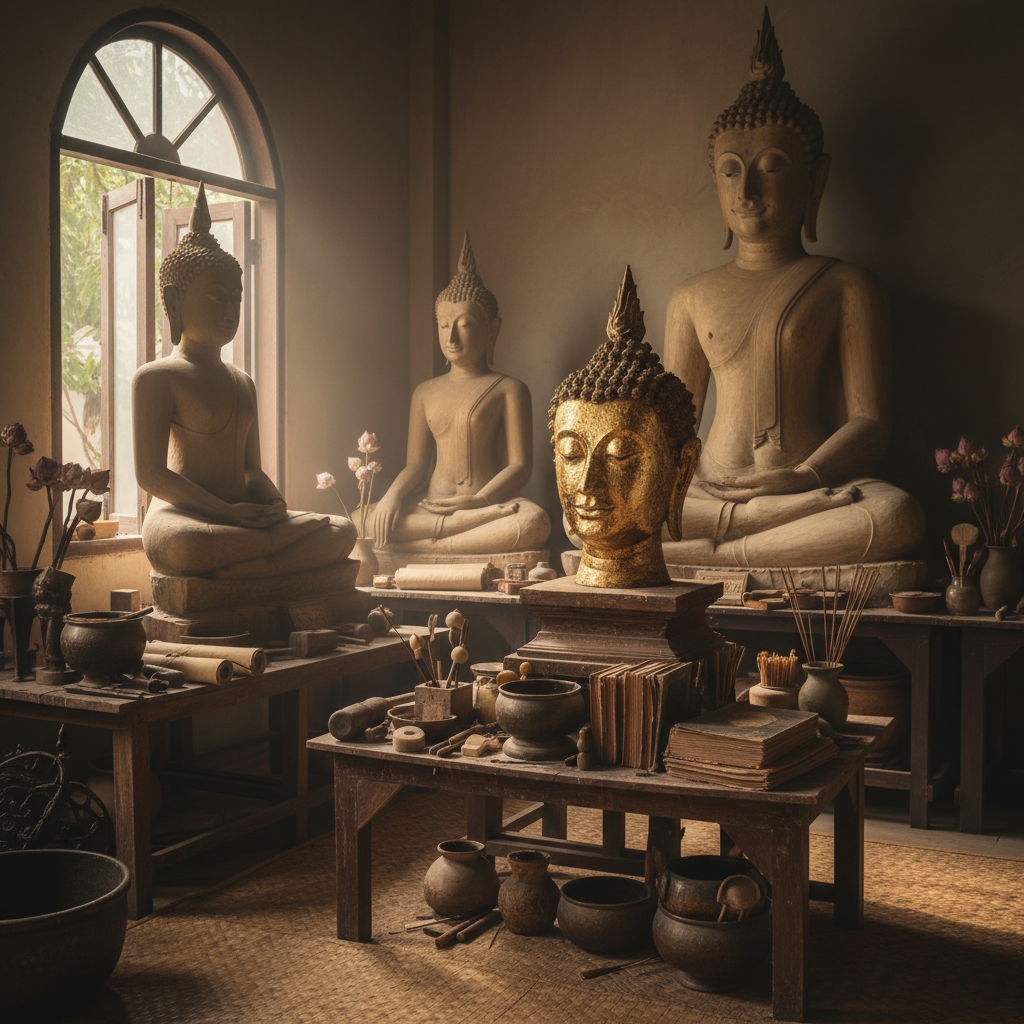
To go beyond the template, it's worth knowing a few secrets. Firstly, time. Arrive at opening time (8:00 am) or close to sunset (after 5:00 pm). Crowds are minimal, the light is perfect for photos, and the atmosphere is meditative. Secondly, little known points. Walk around the main statue and find a small yellow jade Buddha statue in one of the pavilions. Visit the bell tower and ring the bell for good luck (this is a local tradition). Thirdly, rituals. For a small amount of money, you can purchase a thin piece of gold leaf and stick it on one of the small statues, making a wish. This is the very “living” experience that connects you with the original, pilgrimage essence of the place.
Where history is heading: the future of the shrine in the era of mass tourism
Today, the administration of the complex is looking for a delicate balance. On the one hand, funds are needed for maintenance and completion (the project is still not completed). On the other hand, it is important to maintain respect for the shrine. Dress code rules are introduced (scarves and sarongs are provided free of charge), and signs appear asking for silence. In the future, there will likely be modern solutions: official multilingual audio guides, QR codes with history, perhaps even virtual tours for those who cannot climb. The main challenge is not to give temple in Phuket turn into a pure attraction, preserving its soul for future generations.
Your ideal visit: harmony of impressions instead of a tick on a list
So how do you plan a visit based on all this evolution? Ditch the template. If your budget allows, choose a private guide who will tell the story rather than just show you the statue. If you are traveling on your own, allow at least 1.5-2 hours. Come early in the morning. Do not go straight to the large statue, but look around the entire complex around the perimeter. Take part in a small ritual - hang a bell or glue gold leaf. Stand in silence for a few minutes, looking at the panorama. Remember that below you is not just a “viewpoint”, but a place that was built by the entire island, starting as a spiritual symbol. Realizing this evolution - from an idea to a public construction site, from pilgrimage to tourism - you will see in white marble not just a lens for a photo, but the history of the whole of Phuket. And this impression will be much more valuable than any tick on the list of attractions.