




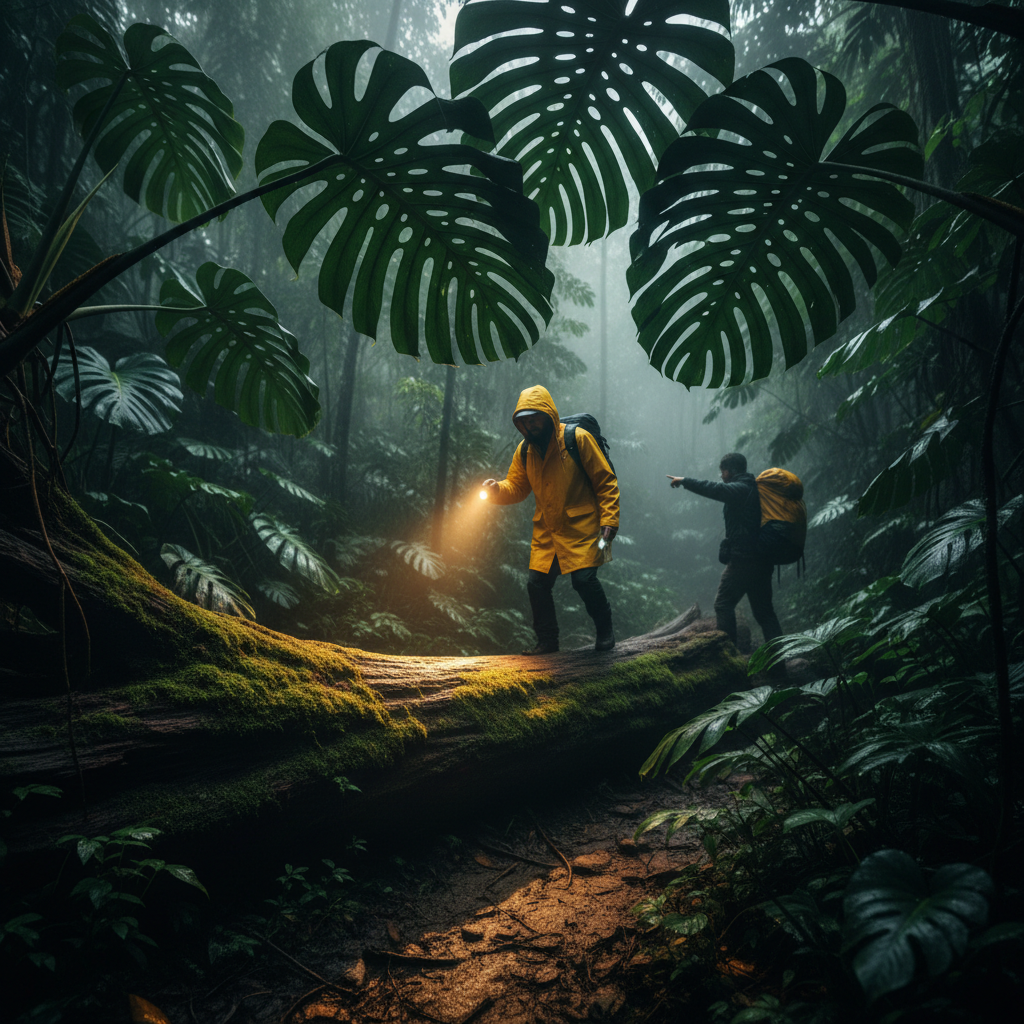
Why is this checklist needed: the story of Alexey, who packed his suitcase incorrectly
Alexey was preparing for his first excursions to the jungle in Phuket with an overnight stay a whole month. He watched dozens of YouTube videos, read forums and bought an expensive trekking backpack. He seemed to have thought of everything. But an hour after the start of the route, his new “breathable” sneakers were soaked through, and the chocolate he had taken for dinner melted in his pocket due to the stuffiness. By evening, Alexey realized that he had forgotten the repellent, and his “ultralight” sleeping bag turned out to be too thin for the tropical night. Instead of adventure, he got a struggle with his own mistakes.
If you're feeling similar anxiety right now—fear that something will go wrong, fear of the unknown—this checklist is for you. It is not about “how to survive in extreme conditions.” It’s about how to get the most out of your experience without risk or discomfort. About your overnight in the Phuket jungle remembered by the singing of cicadas and the light of fireflies, and not by wet socks and a hungry rumbling stomach.
Category 1: Equipment - what will really be useful and what will be extra weight
The main rule of the jungle: every extra gram on the plain turns into a kilogram on the rise. But you cannot save on critical things. Let's figure out what you really need to put in your backpack, and what it's better to refuse.
Shoes: your main investment
Forget about fitness sneakers. The jungle features wet slopes, slippery roots and streams. Ideal choice - high-top trekking boots and an aggressive tread. They will protect your ankle from spraining and will not get wet after the first ford. If you are going on an organized tour, where the route does not involve serious obstacles, aquashoe sandals with a closed toe are suitable - they dry quickly and do not slip on wet stones.
Clothing: the principle of three layers in a tropical way
Humidity in Phuket is close to 80%, so cotton is your worst enemy. It gets wet from sweat and does not dry, causing hypothermia even at +25 °C. Correct equipment:
- Base layer: synthetic T-shirt or thermal underwear with ultraviolet protection (UPF 50+).
- Middle layer: Light fleece jacket - it warms even when wet and dries quickly.
- Top layer: raincoat or poncho. The jungle is a tropical forest, where rain can start suddenly and last for hours.
Be sure to take trekking pants, which transform into shorts. They will protect your legs from leeches and thorns, and on a hot afternoon you can unfasten your trouser legs.
What to leave at the hotel
Don’t take: an umbrella (useless in thickets), jeans (they get wet and take days to dry), a large camera with three lenses (a smartphone with a good camera is more than enough), a cosmetic bag with a full set of skincare products. Every gram counts.
Remember: your backpack should not weigh more than 7-8 kg. Everything that does not fit into this limit remains at the hotel. The jungle does not forgive overload.
Category 2: Food and water - how not to go hungry and not get poisoned
In conditions of high humidity and heat, food spoils many times faster than in the city. A power supply error can turn trekking Phuket overnight into a nightmare with an upset stomach. Here's how to avoid it.
Water: the main resource
The consumption rate in the jungle is 1.5-2 liters per person per day. But carrying 4 1.5 liter bottles with you is not an option. Solution: take hydrator (drinking system) volume 2-3 liters and water disinfection tablets (for example, based on chlorine or iodine). There are many streams in the Phuket jungle, but you cannot drink raw water from them - the risk of contracting a bacterial infection is too high. The tablets disinfect water in 30 minutes, and you will always have a supply.
Food: what to take so it doesn’t spoil
Forget about sausage sandwiches and dairy products. Your overnight diet:
- Nuts and dried fruits - high in calories, compact, does not spoil.
- Energy bars - an ideal snack at a rest stop.
- Freeze-dried cereals - pour boiling water from a thermos, wait 5 minutes, and the hot dinner is ready.
- Canned food (fish, meat) - only if you are sure that you can take the can away and then dispose of it.
If you go with an organized group, the issue of food is usually resolved - the guide cooks over a fire. But you should still have a snack in your backpack: the appetite in the jungle is brutal, and there’s still a long way to go before dinner.
What absolutely should not be done
Do not pick or eat wild fruits and berries, even if they look tasty. Local species can be poisonous, and it is impossible to identify them by eye without botanical education. Do not drink water from streams without treatment - this is the most common cause of poisoning among tourists.
Category 3: First aid kit - from mosquitoes to scratches
The jungle is no place for heroism. A scratch on bamboo or an insect bite here can lead to serious consequences if the wound is not treated in time. Your first aid kit should be compact but effective.
Mandatory minimum
| Means | Why | Note |
|---|---|---|
| Repellent (contains DEET 30-50%) | Protection against mosquitoes, midges, midges | Apply to exposed areas of the body every 3-4 hours |
| Antihistamine (tablets + ointment) | For allergies to bites and plants | The itching from the bite can be unbearable, the ointment will relieve the swelling |
| Antiseptic (chlorhexidine or peroxide) | Treatment of cuts and abrasions | Wet wipes with antiseptic - convenient format |
| Plasters of different sizes + bandage | Protecting wounds from dirt and moisture | Even experienced tourists get calluses |
| Diarrhea medicine (smecta, loperamide) | In case of poisoning or reaction to new water | Better to have than to search in the jungle |
| Painkillers (ibuprofen, paracetamol) | Headache, muscle pain after exercise | Relieves fever if you have a cold |
Leeches: myths and reality
Leeches in the Phuket jungle are not a horror story, but a reality. They do not carry dangerous diseases, but their bites can bleed for several hours due to the anticoagulant in their saliva. Do not panic, do not tear off the leech by force - this will cause suppuration. Just drop some alcohol, salt or repellent on it and it will fall off on its own. Treat the wound with an antiseptic and cover it with a band-aid.
The main enemy in the jungle is not snakes or spiders, but an infected scratch. Treat any wound, even the smallest one, immediately.
Category 4: Navigation and communication - how not to get lost and call for help
If you are going with a guide, you can skip this section. But for those who are planning independent trekking Phuket overnight, navigation is a safety issue. Mobile communications in the jungle are not available everywhere, and the paths are often not marked.
Offline cards are your insurance
Download the Maps.me or Organic Maps app and download the Phuket map offline. Mark on it the starting point, finish point and place of the proposed overnight stay. Even if you get lost, you can find your way using GPS. Important: the battery charge will last for 4-6 hours of active GPS use, so a power bank is required.
Power bank: which one to choose
Take a power bank with a capacity of at least 10,000 mAh. This is enough to charge your smartphone 2-3 times. Ideally, a model with moisture protection (IP67 standard). A regular power bank may fail in high humidity conditions. Place it in a hermetic bag along with your phone and power bank.
Signals and backup plan
Before leaving, tell someone you know or the hotel administrator about your route and approximate return time. If you do not get in touch within the agreed time frame, this is a signal to search. You should always have a whistle in your backpack - the sound in the jungle can be heard further than a scream. And don't forget a headlamp with spare batteries: it gets dark in the tropics sharply, around 18:00, and you risk being left in complete darkness.
Category 5: Overnight - choose a place and prepare for the dark
A night in the jungle is magical. But to prevent it from turning into a test, you need to choose the place for your tent wisely.
Rules for choosing a place
- Don't pitch your tent in low areas. Moist air accumulates there and water can stand there after rain. Choose higher ground.
- Avoid dry trees and large branches. They may fall during wind or rain. Check to see if there are any “dead” trunks overhead.
- Stay away from anthills and termite mounds. At night, these insects become active, and your dinner may become their dinner.
- Distance from water. Do not place your tent closer than 50 meters from a stream - during a rainstorm, the water level may rise and the humidity near the water is higher.
Protection from rain and wild animals
An awning over a tent is not a luxury, but a necessity. Even if the forecast promises clear weather, a tropical downpour can begin within 10 minutes. Stretch the awning so that the water flows away from the entrance. As for animals: large predators are very rare in Phuket. The only thing that can come to visit you is monkeys or wild boars. They are greedy for the smell of food. Place all food in a hermetic bag and hang it on a tree at a height of 3-4 meters, away from the trunk. Never leave food in a tent.
Lighting organization
The darkness in the jungle is absolute. A headlamp is your best friend. It frees up your hands for cooking dinner or setting up a tent. Take two: the main one and a spare one (cheap, but working). Battery-powered LED garlands will create a cozy atmosphere and help you avoid tripping over roots in the dark.
How to use a checklist: from printing it to packing your backpack
A checklist is not just a tick list. It is a tool that turns chaos into order. Here's how to put it into practice so that your excursion to the jungle in Phuket with an overnight stay went perfectly.
- Print out the checklist. Yes, you can save it in your phone, but the paper won't run out or get wet if you pack it into a file. Post the list in a visible place the day before you go out.
- Organize things into categories. Equipment, food, first aid kit, navigation, overnight stay. This way you won’t forget anything and won’t put in too much.
- Reassemble the backpack in reverse order. Place whatever you need first (water, snacks, raincoat) on top. What you need only in the evening (sleeping bag, change of clothes) goes to the bottom.
- Check the weight. Step on the scale with your backpack. If more than 8 kg, reconsider the contents. You go to enjoy nature, not carry stones.
- Make a follow-up call. Tell us your route and return time. It's a simple habit that saves lives.
Now you know everything to turn fear of the unknown into confidence. The jungles of Phuket are waiting for you - and they are much friendlier than they seem if you approach them wisely. Put things on the list, breathe out and go on an adventure. It's worth it.