




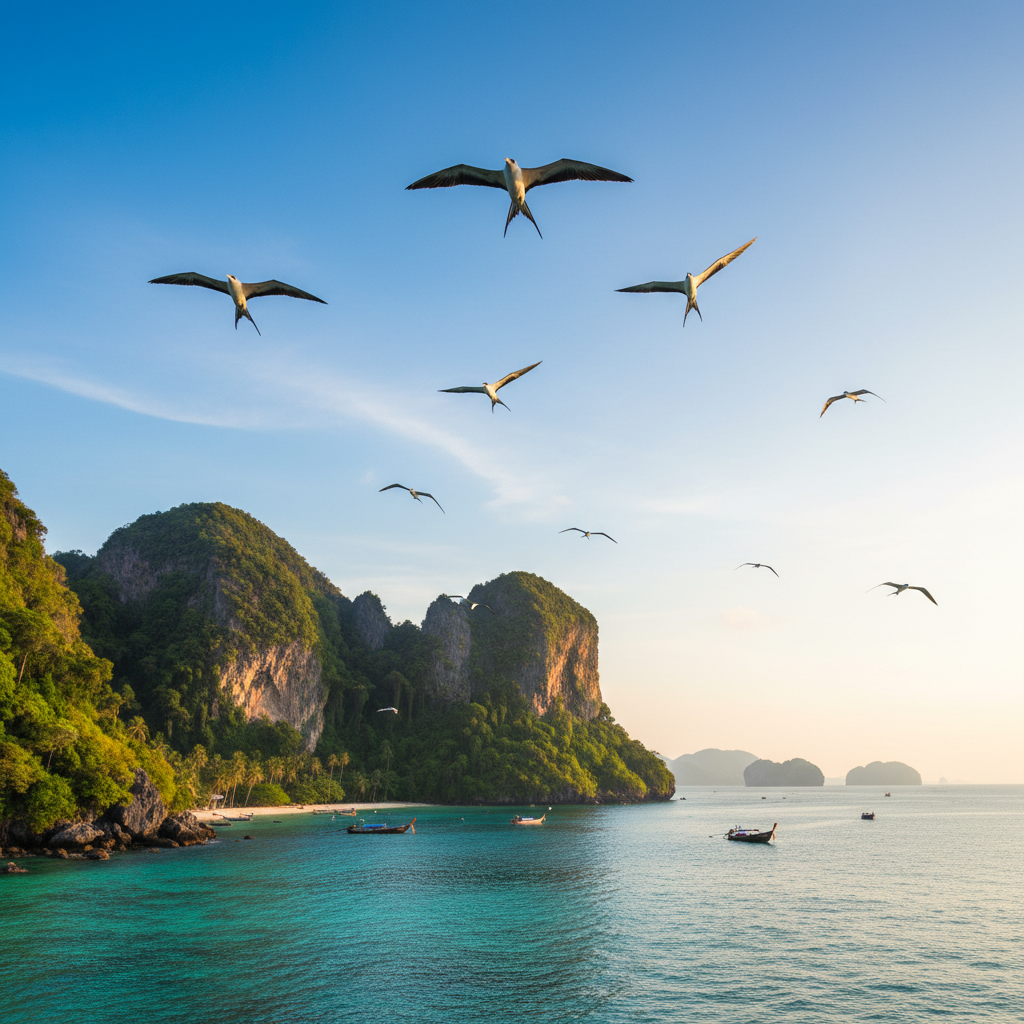
The birth of the excursion market: from fishing boats to the first charters
More than 60% of travelers flying to Phuket include at least one organized excursion program in their trip. Today it is a billion-dollar industry, but this was not always the case. To understand how the modern market was formed excursions in Phuket, it is worth looking into its recent past - to the 1980s and 1990s, when the island was just beginning to open up to international tourism.
In those days, the concept of “excursion program” in our usual form did not exist. Local fishermen, owners of small boats, offered visitors a simple deal: for a few dollars they would take the group to the neighboring islands - Ko Kai Nok, Ko Yao Yai or to Phang Nga Bay. No amenities, no insurance, no schedule. The route depended on the weather and the mood of the captain. It was these informal boat trips that became the prototype of future Phuket excursion programs.
By the mid-1990s, when the flow of tourists began to grow, the first companies appeared that tried to bring order to this chaos. They rented entire ships, developed fixed routes and began offering tours to Phuket with transfer and lunch included. This was the first step from a spontaneous market to an organized one. However, the quality remained low: the boats were old, the security was formal, and the guide was often limited to a couple of phrases in broken English.
The excursion market in Phuket has gone from impromptu fishing trips to premium yacht cruises - and this path clearly reflects the evolution of all Thai tourism.
The era of group tours: standardization and the battle for the mass tourist
The period from 2000 to 2010 was the heyday of mass tourism in Phuket. The island has become one of the top destinations in Southeast Asia, and with it excursions in Phuket turned into a conveyor belt. Large tour operators working with hotels and airlines have standardized their offerings to the extreme.
What a typical group tour looked like
The program was the same for everyone: get up at 6 am, bus to the pier, board a boat for 40-60 people, stop for snorkeling in a crowded bay, lunch in a tourist restaurant with crowds of the same groups, an hour on the beach and return. The routes copied each other: Phi Phi Islands, James Bond, Similan Islands. The only difference between the companies was the price and volume of music on board.
This model had obvious advantages. First, availability: cost Phuket excursion programs in the group tour format was minimal. Secondly, the ease of choice: the traveler did not need to plan anything; it was enough to buy a tour in the hotel lobby or on the street. However, the disadvantages turned out to be critical.
The main loss is authenticity. The traveler saw not the real Phuket, but its tourist scenery. Local markets, temples, villages remained behind the scenes. Time at locations was strictly regulated, and contact with nature was limited to staged photos. By the end of the 2000s, many independent travelers developed persistent disappointment: “excursions in Phuket are crowds, noise and the same thing”.
The Pivot to Personalization: How Private Guides Changed the Game
Around 2012–2013, noticeable changes began to occur in the market. There was a request for an individual approach. Travelers, tired of the conveyor belt, began to look for an alternative. In response to this, a layer of private guides and small companies emerged offering individual excursions in Phuket.
What has changed fundamentally? Firstly, group size. Instead of a bus for 50 people, there is a jeep or a boat for 4-6 passengers. Secondly, route flexibility. The client could decide for himself how much time to spend on the beach, whether to stop at the market or skip the obligatory stop with coconuts. Thirdly, the depth of immersion. Private guides, often local residents with a good knowledge of history and culture, offered not just to “see”, but to understand.
This format quickly gained popularity among those who came to Phuket not for the first time, as well as among families with children and couples who value comfort. Demand for individual excursions Phuket began to grow, and the market responded: programs appeared with street food tasting, master classes in Thai cuisine, trekking in the jungle with a biologist.
It is important to note that personalization did not cancel group tours - they remained as a budget segment. But it was during this period that a clear division emerged: cheap and standard or more expensive, but truly.
State of the Art: Offer Segmentation and Digital Platforms
Today's market excursions in Phuket is a complex multilayer structure. It is segmented not only by price, but also by the type of experience the traveler is looking for. To navigate this diversity, it is worth understanding the main categories.
| Format | Group size | Cost (per person) | Key Feature |
|---|---|---|---|
| Group tour (economy) | 30–50 people | $20–40 | Fixed route, basic service |
| Small group (standard) | 8–15 people | $50–80 | More comfortable transport, guide |
| Individual excursion | 1–6 people | $100–250 | Full route customization |
| Premium tour (yacht/boat) | 2–10 people | $300–800 | VIP service, chef, private locations |
Digital platforms and aggregators play a key role in choice today. The traveler no longer relies on street agents - he reads reviews, compares photos, studies routes on the map. This has led to the quality of services becoming more transparent. Companies offering tours to Phuket, are forced to compete not by price, but by the uniqueness of the program and the level of service.
If you are planning a trip and are wondering “what to see in Phuket”, the modern market offers options to suit every taste, from a budget day out on the Phi Phi Islands to a private food expedition along the south coast. The main thing is to clearly understand which format meets your expectations.
Where the industry is heading: sustainability, micro-tours and immersive experiences
Market Phuket excursion programs continues to evolve. Based on current trends, several directions can be identified that will determine its development in the next 3–5 years.
The first is environmental friendliness. Overload of popular locations (Maya Bay, Phang Nga Bay) has led to the Thai authorities introducing restrictions on the number of visitors. In response, tour operators are beginning to offer alternative routes: lesser-known islands, morning departures before the massive influx of tourists, beach cleaning programs. Sustainable tourism is no longer a niche trend and is becoming a must-have standard.
The second is micro-tours. Instead of a whole day on the water, travelers are increasingly choosing short but intense programs: 3-4 hours with a specific goal - snorkeling in a certain reef, visiting a temple with a historian guide, an evening walk at sunset. This avoids fatigue and gives you a more focused experience.
The third is immersive experience. Just “looking” is no longer enough. Travelers want to participate: cook Thai food with a local family, learn to sail a boat, scuba dive in little-explored places. Technology is also coming into play: Some companies are already testing AR guides that overlay historical information on the real landscape through a smartphone screen.
Evolution excursions in Phuket — a move away from uniformity towards variety. Today travellers can choose not merely between expensive and cheap, but between different approaches to a holiday. That choice is becoming increasingly considered.