




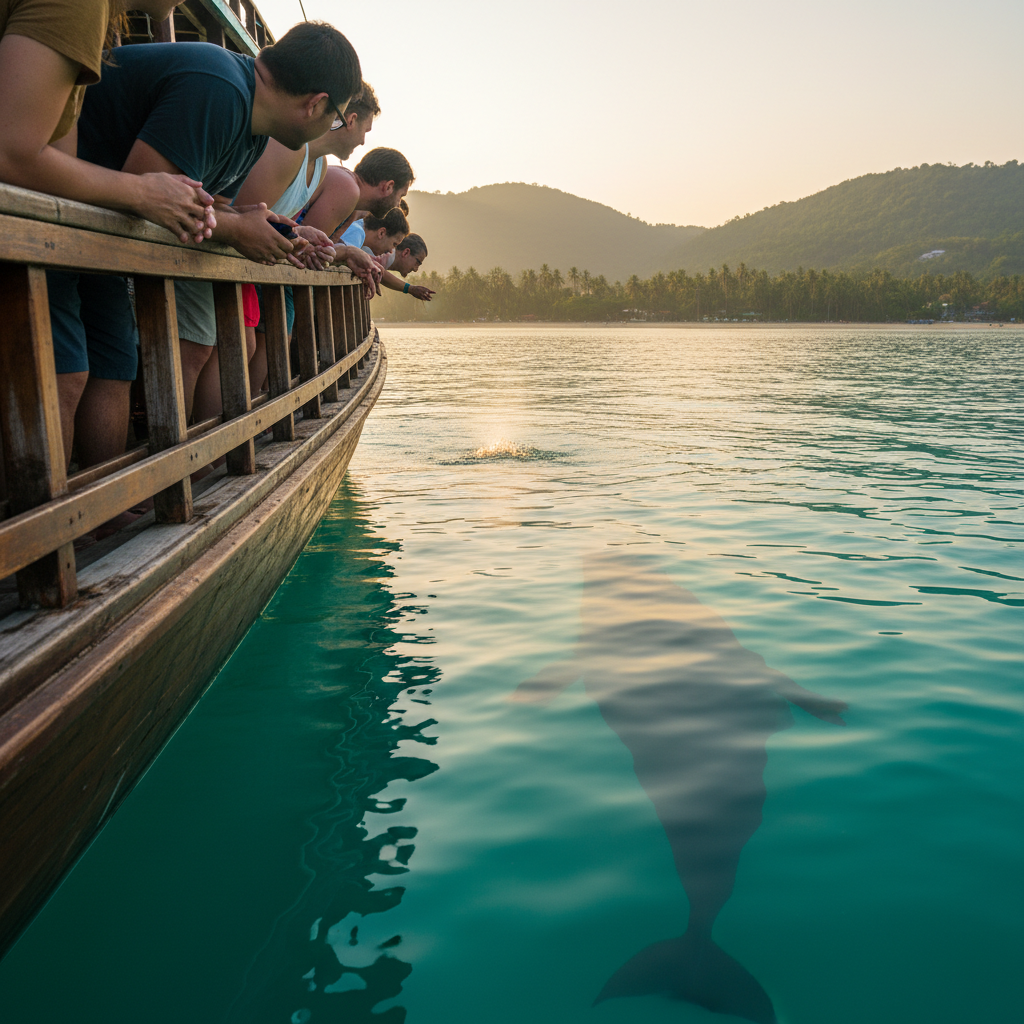
Goal: See whales in their natural environment in one trip to Phuket
You have arrived in Phuket, ready to meet the whales, but there is fear inside: “What if I waste my money, swim for half a day in the sun and return with nothing?” This fear is the main reason why many tourists refuse an excursion or are disappointed in it. Our goal is to give you a clear, step-by-step tool that turns chance into guaranteed results. You will learn not just general tips, but a specific algorithm: when to buy a ticket, which company to choose, where to look on the water and what to do to make a meeting with whales take place. No theory - just working steps.
Preparation: three steps before purchasing excursion tickets
Success begins not on the boat, but on the shore. Most unsuccessful tours are the result of improper preparation. If you skip any of the three steps below, your chances of seeing whales drop dramatically. Let's look at each one.
Step 1. Select the season with the highest probability of meeting
Whales off the coast of Phuket are not a year-round phenomenon. If you come in May or October, most likely you will see only the sea and seagulls. Working season - from November to April. During this time, Bryde's whales, humpback whales and sometimes blue whales migrate through the Andaman Sea. It is during these months that the likelihood of a meeting reaches its maximum. Plan an excursion to mid-season - January or February: the water is calmer and the whales stay closer to the shore.
Step 2. Check the tour operator according to three criteria
Not all companies selling whale watching excursions in Phuket are equally useful. Many are simply intermediaries who take tourists along the standard “see the fish” route. To avoid falling into such a trap, check the operator on three points:
- Availability of a biologist guide. Conscientious companies hire a specialist who knows the habits of whales, their feeding places and can read signs on the water. If the tour description does not mention a biologist guide, this is a red flag.
- Small group. Ideally - up to 10-12 people. Large boats make noise, scare the animals, and the captain cannot maneuver. A small group is a backup plan and an opportunity to get closer.
- Specializing in whales. Look for operators who have whale photos and videos in their portfolio, not just a “sightseeing tour.” Specialized tours are more expensive, but the result justifies the price.
Step 3: Study the Phuket Whale Route Map
Whales do not swim chaotically. They have permanent feeding areas. Knowing them, you reduce your search time. Main exit points:
- Similan Islands region - the main gathering place for Bryde's whales. They come here for plankton. If the tour promises Similan, that’s a plus.
- Surin Islands — a little farther away, but also a reliable choice. Humpback whales are seen here more often.
- Cape Phanwa - the point closest to Phuket. Whales come here at the beginning of the season (November–December). If time is short, choose a tour departing from Phanwa Cape.
Avoid routes that are limited only to Chalong Bay or the southern coast of Phuket. There, whales are rare guests, and the excursion will turn into a walk on an empty sea.
Activities on the day of the excursion: what to do on the water
You have chosen the season, checked the operator and know the route. Now comes the most important part: behavior on the boat. Even a perfectly prepared tour can fall apart if you don't know how to look for whales.
Start at 6:00 and the first hour rule
Most successful tours start at 6am. This is not a whim of the organizers - whales are active at dawn. After 9–10 am they go deeper or into the shadows, and it becomes more difficult to notice them. The first hour after leaving is the golden hour. At this time, the captain and guide scan the horizon, looking for fountains, splashes, shadows. Your task is not to be distracted by breakfast and photos, but to carefully look around. If after 40 minutes there is nothing, don't panic, but be prepared to change your position.
Observation technique: where to look for fountains and shadows
Whales give themselves away in several ways. Learn to read them so you don't mistake a dolphin for a whale and miss your target:
- Fountains. Whales exhale air with a characteristic noise, forming a column of water 3–5 meters high. If you see a fountain, it's almost guaranteed to be a whale. Dolphins don't make fountains.
- Shadows under water. In clear weather, the silhouette of a whale is visible at a depth of 2–3 meters. Look for dark spots that move against the current or wind.
- Bird behavior. Gulls and terns often circle the whales' feeding grounds. If you see a cluster of birds, the captain should direct the boat there.
- Splashes and tails. When a whale dives, it raises its tail. It's a spectacular moment, but it's rare. More often than not, you'll just see a smooth back surfacing.
Don't shout or wave your arms - this scares the animals. It is better to quietly indicate the direction to the guide. An experienced captain will approach a safe distance (usually 50–100 meters) and turn off the engine so as not to interfere.
Result: you come back with photos and memories, not resentment.
When all the steps are completed - the season is chosen, the operator is checked, the route is studied, and on the water you act according to the first hour rule and observation technique - the result becomes predictable. You are not just “swimming somewhere”, but purposefully looking for whales in their natural environment. Even if the day of the excursion is cloudy or slightly windy, your chances remain high because you are prepared. You return to shore with photos, videos and the feeling that you spent your money well. No offense at the empty tour - just a desire to repeat it. And if the whales still don’t show up (this happens, although rarely), you will at least know that you did everything possible, and you can reschedule the excursion to another day without loss of quality.