




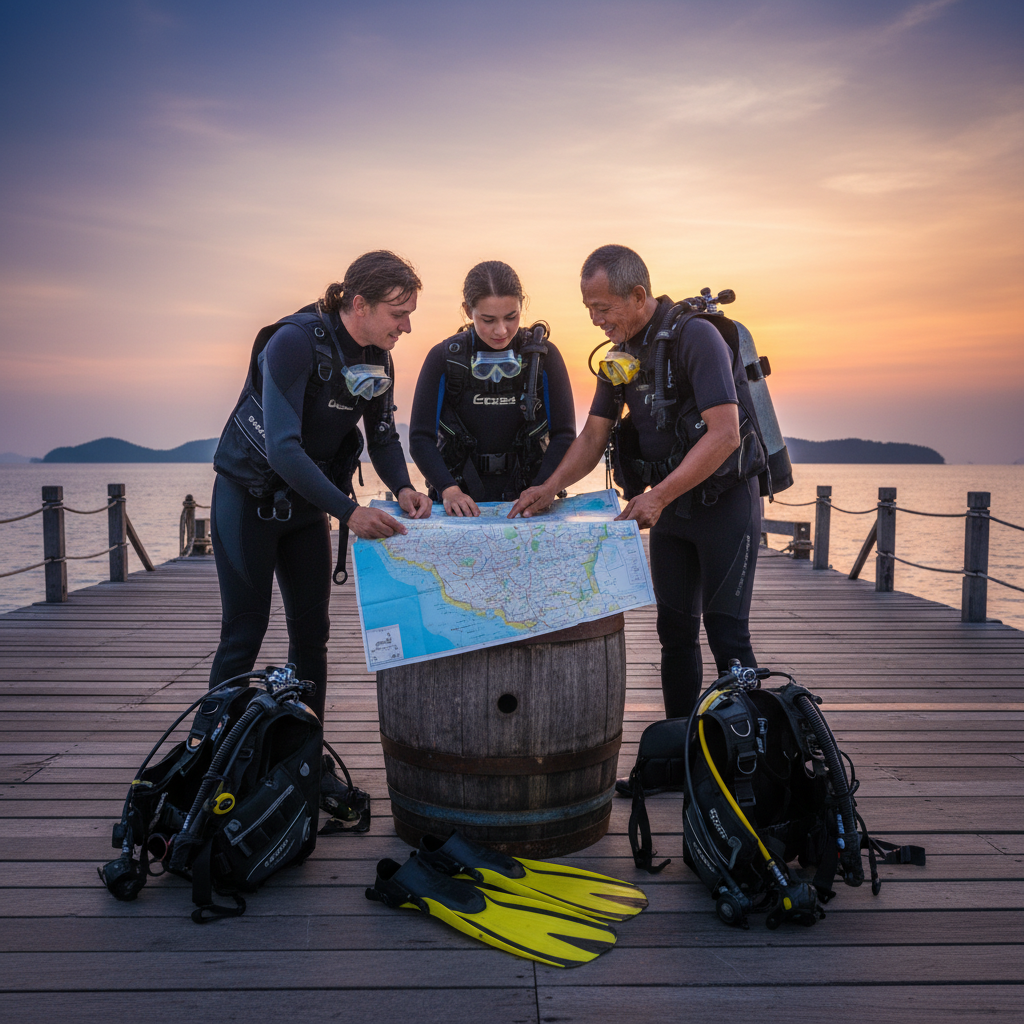
Should a beginner dive straight into scuba diving or is it better to start with snorkeling?
How to choose the very excursion so that it becomes the best memory and not a disappointment? The first thing a tourist encounters in Phuket is the temptation to immediately put on scuba gear and go into the depths. However, the difference between snorkeling (snorkeling) and diving (tank diving) is much deeper than it seems at first glance.
Snorkeling — an ideal starting point if you are unsure of your fitness or simply want to try being in the water. You do not need to complete a briefing, you breathe normally, and the only equipment is a mask, snorkel and fins. You see corals and fish from the surface, which is often enough for a memorable experience. The drawback is that you cannot descend to drop-offs or see nurse sharks and turtles close up.
Test diving (Intro Dive) — an entirely different level. Even for a single dive, you need 30–40 minutes of theory: how to equalise pressure in your ears, what to do if your mask fogs up and how to breathe through a regulator. It is not frightening, but it requires attention. If you are willing to learn on holiday and are not afraid of water, diving offers feelings that snorkelling never can.
The main rule: if you swim uncertainly or panic in the water, start with snorkeling. Diving requires calm and controlled breathing. Don’t overestimate your strength: it’s better to enjoy the mask than to ruin your day with fear in the depths.
The optimal strategy for a beginner in Phuket is a combined tour: in the morning you undergo instruction and do one dive with an instructor, and in the afternoon you snorkel in the lagoon. This way you will try diving without overloading yourself.
Which destinations around Phuket are considered the standard for diving and why
There are dozens of dive sites within a 2-3 hour boat ride from Phuket. But not all of them are equally good for different levels of training. In order not to be disappointed, you need to understand what awaits under water.
Similan Islands
This best diving spots Phuket according to 9 out of 10 divers. National park closed to the public from mid-October to May. The underwater world here is a standard: crystal visibility up to 30 meters, giant granite boulders covered with corals, manta rays, turtles, barracudas. Minus: The journey takes 1.5–2 hours by speedboat, and the excitement can be strong. Beginners feel comfortable here, but only in calm seas.
Phi Phi Islands
Popular destination for day trips. Underwater there are colorful coral gardens and many tropical fish. Plus: close to Phuket (45–60 minutes). Minus: many tourists, the water is often cloudy due to the large number of boats. It's a good option for a first dive, but experienced divers often find Phi Phi "boring."
Karen Bay (Koh Haa) and Phang Nga Bay
Karen Bay is made up of five limestone islands with caves and grottoes. Underwater there are soft corals, seahorses, and sometimes leopard sharks. Ideal for experienced diverswho want to explore the terrain. Phang Nga Bay is more about snorkeling and picturesque views above the water; underwater there is less life here, but there are no currents - safe for beginners.
| Location | Travel time | Difficulty level | underwater world | Recommendation |
|---|---|---|---|---|
| Similan | 1.5–2 hours | Medium | Manta rays, turtles, barracudas | Best choice for all levels |
| Phi Phi | 45–60 min | Low | Corals, fish | For the first time or snorkeling |
| Karen Bay | 1–1.5 hours | High | Caves, grottos, sharks | For experienced divers |
| Phang Nga | 30–40 min | Very low | Modest | For snorkeling and scenery |
Conclusion: if you are looking diving in Phuket with maximum “wow” effect - choose Similans. If you want a calm day without rocking, go to Phi Phi or Phang Nga.
Success story (Inspiring example: how it turned out to be cool): How a group of beginners discovered the underwater world on the Similan Islands in one day
Imagine: three friends, none of them have a PADI certificate. The most they did was snorkel in the pool. They decided that once they came to Phuket, it was “either now or never.” We chose a tour to Similan with test diving.
In the morning they were met by a Russian-speaking instructor with 10 years of experience. Instead of just handing out equipment, he spent 40 minutes explaining how to breathe, how to blow out your ears, and what to do if your mask floods. Then - a dive in the lagoon to a depth of 5 meters, where you could stand on the bottom. After 15 minutes the group felt confident.
The second dive is already at the wall of a coral reef at a depth of 12 meters. One of the friends saw a turtle that swam a meter away from him. The emotions were such that after surfacing, he admitted: “I didn’t think it was possible to breathe underwater and see this.” In the evening they were already looking for PADI courses for the rest of their vacation.
The key success factor is not a “steep” route, but a competent instructor who took the time to prepare. A good operator will never throw a newbie into the water without explanation. If they promise you “just jump and swim”, run away from such an operator.
This example shows: even without experience, you can get the most if you choose the right excursion. Diving excursions Phuket can be safe and unforgettable if you make the choice consciously.
How much do high-quality diving excursions really cost and what can you save on without losing your impressions?
Prices for diving Phuket excursions vary from 2,500 to 10,000 baht per day. Let's figure out what the cost is and where you can save money wisely.
Price structure (using the example of a one-day tour to Similan)
- Transfer (hotel - pier - hotel): 300–500 baht
- Equipment rental (full set: wetsuit, BCD, regulator, mask, fins): 800–1,200 baht
- Lunch and drinks: 300–400 baht
- Instructor services (group - 1 instruction for 4–6 people): 1,000–1,500 baht
- Entrance fees to the national park: 500–600 baht
- Insurance (required for diving): 200–400 baht
Total: basic group tour - from 3,500 baht. Premium (individual guide, small group, best equipment) - from 7,000 baht.
How can you save money without losing quality?
- Equipment: If you have your own mask and snorkel, bring them. This will save 200-300 baht and will be more hygienic.
- Group: choose a tour with a group of up to 6 people. It costs a little more than for 12–15 people, but the instructor will pay more attention to you and the safety is higher.
- Food: Don't skimp on lunch - a quality lunch on the boat costs money, but you can bring your own snacks.
What not to do: buy the cheapest tour for 1,500 baht. This price often does not include insurance, the equipment may be old, and the instructor may not be certified. Saving 1,000 baht can result in a ruined day or health problems.
What risks await an inexperienced diver in Phuket and how to minimize them
Diving is one of the safest outdoor activities if you follow the rules. But there are specific risks in Phuket that you should know about in advance.
Main risks
- Unqualified instructor. There are “specialists” on the market who have completed crash courses. Check certifications: the instructor must have a valid PADI or SSI card.
- Bad equipment. Old regulators, cracked masks, broken buoyancy compensators. Before diving, check everything yourself or ask the instructor to show that the equipment is in good working order.
- Weather conditions. From May to October is the monsoon season in Phuket. Waves can reach 2–3 meters, visibility under water decreases. The best time for diving is from November to April.
- No insurance. Medical insurance for diving is not an option, but a mandatory requirement. If you dive without it, any incident (barotrauma, decompression) can cost a pretty penny.
How to minimize risks
- Choose an operator with good reviews on independent sites (TripAdvisor, Google Maps), and not based on advertising in the hotel.
- Do not buy a tour secondhand on the beach - such sellers often do not have a license.
- Before diving, inform the instructor of any health problems (asthma, ear problems, cardiovascular diseases).
- Do not dive if you feel tired, drank alcohol the night before, or have a cold.
Golden rule: if something doesn’t go according to plan, come up. Diving is not a competition. It is better to abort the dive than to risk your health.
What is the difference between commercial diving in Phuket and amateur diving and what to choose for one dive
Many people confuse “commercial diving” (which is offered by travel agencies) and “recreational” (which is practiced by certified divers). In fact, the difference is not in quality, but in format.
Commercial diving (Intro Dive) — an introductory dive for people without certification. You pay for a day that includes a briefing, equipment and an instructor accompanying you. Depth is limited to 12 metres. You do not receive a certificate, but you gain the experience. It is ideal for a single dive if you do not plan to take up diving seriously.
Fun Dive - for certified divers. You are responsible for your own equipment, plan the dive and can dive to a depth of 30 meters (with Advanced Open Water). If you have a PADI certificate, you can join a group and have more freedom.
What to choose for one dive? If you have never dived - only Intro Dive. If you have a certificate, but haven’t dived in a year, it’s better to take a test dive with an instructor (Refresher) to remember your skills.
Many tourists, after the first Intro Dive in Phuket, decide to take the full PADI Open Water course. It takes 3-4 days and costs around 12,000-15,000 baht. If you fall in love with the underwater world, this is the best investment in your future travels.
Choice diving excursions in Phuket — an informed decision rather than a lottery. Assess your ability, set a budget, read reviews of the operator and do not chase the lowest price. Your best holiday memory is worth some preparation. Remember: underwater, you are not simply observing; you become part of another world. That world is open to anyone ready to approach it respectfully.