




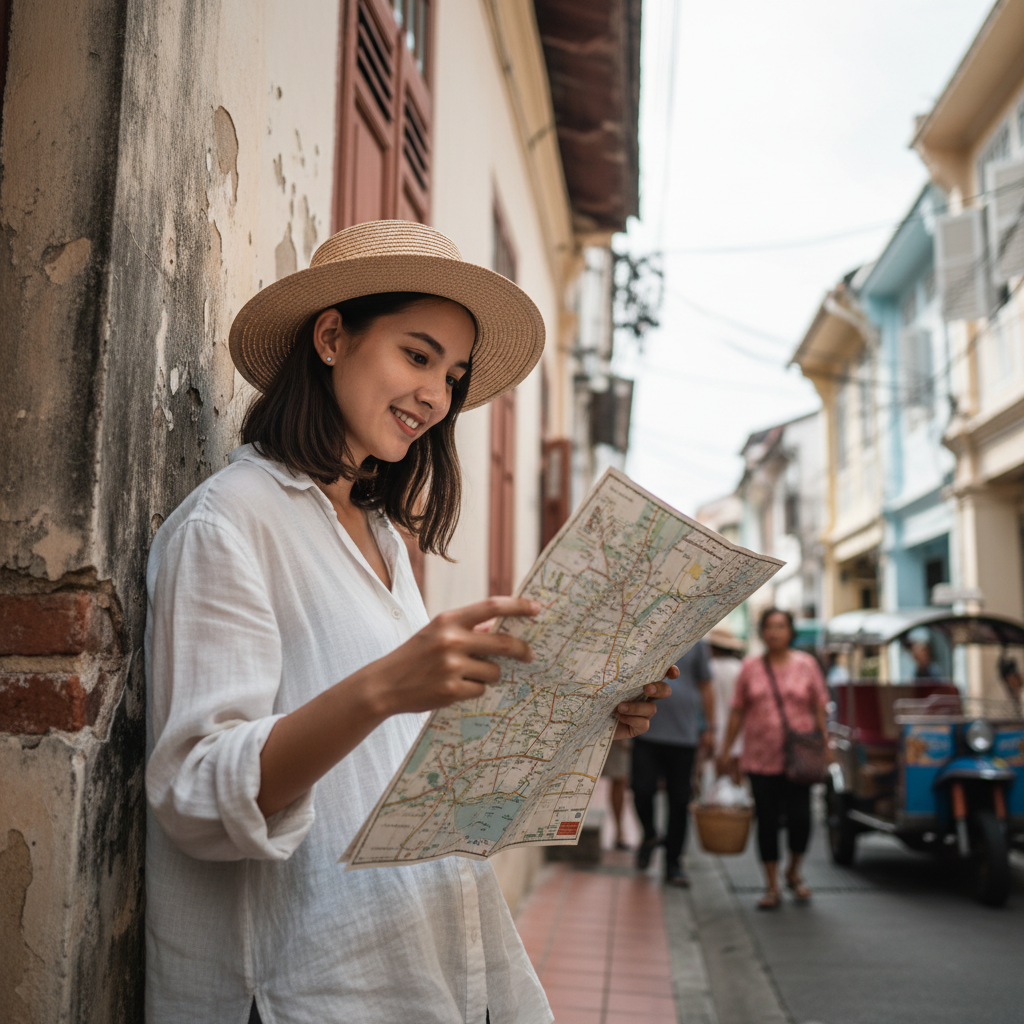
Imagine: you turn off the busy tourist street of Patong into a narrow alley in the Old Town of Phuket Town. The noise of mopeds gives way to silence, and instead of neon signs in front of you are the facades of ancient Sino-Portuguese mansions. This is the threshold of the very excursion you are reading about. But what is it really? This is not just a walk along the colorful streets, but a key to understanding the island, whose history is far from the stereotypes of a beach paradise. We will objectively analyze what is hidden behind the guides' suggestions so that you can evaluate the real value of this experience for yourself.
What is included in a standard tour of Old Phuket?
Typical itinerary for group or individual excursions around old Phuket concentrates on several key streets of the historical center: Thalang, Krabi, Dibuk and Phang Nga. The main focus is the external inspection and history of iconic buildings in the style Sino-Portuguese architecture. Guides usually talk about the tin rush period of the late 19th and early 20th centuries, when Chinese migrant miners built these luxurious mansions, mixing European forms with Oriental decor.
The program almost always includes a visit to one or two places of worship, for example, the Put Jo Temple or the Chinese sanctuary of San Chao Phra Phut. The route often ends at the observation deck at Khao Rang Hill or at a local cafe, where you can taste traditional sweets. However, the depth of immersion varies: some guides limit themselves to general facts, others can show hidden courtyards or talk about the fate of specific families. It is important to understand that most historic mansions, which are private homes, shops or offices, are not entered - you explore them from the outside.
How does a group tour differ from an individual one in the context of the Old Town?
The choice of format directly affects the experience. A group tour (by minibus or on foot) is, first of all, budget saving and a predetermined, proven route. Its disadvantages are limited time at each site, a general pace tailored to the group, and a minimum of opportunities to ask custom questions. This option is suitable for a first, introductory acquaintance with Phuket Town.
Individual walking tour of Phuket offers flexibility. You can shift the focus from architecture to gastronomy, linger at the façade you like, or turn into a non-tourist alley. A professional guide will be able to answer in-depth questions about cultural characteristics that are critical for thoughtful travelers. It's more expensive, but it turns a walk into a dialogue rather than a monologue. The decision depends on priorities: a budget “tick” or a personalized immersion.
| Criterion | Group excursion | Individual excursion |
|---|---|---|
| Cost | Low (from 1000-1500 THB per person) | High (from 3000-5000 THB per tour) |
| Route flexibility | Fixed, does not change | Can be adjusted as desired |
| Depth of information | General, for a wide audience | Detailed, with answers to specific questions |
| Tempo | Medium, set by group | You determine |
| Ideal for | Budget travelers, first study tour | History buffs, photographers, families with children, those who want to delve deeper into the topic |
Self-guided route or guide: which is more effective for immersing yourself in history?
An independent walk gives you complete freedom: you can build your route according to old town of Phuket, go to any museum you like (for example, Thai Hua Museum), take endless photographs and sit in a cafe. However, without preliminary preparation, you risk seeing only beautiful facades, missing the context. Why are the styles mixed here? What do the figures on the pediments symbolize? How is a “shophouse” different from a mansion?
The guide acts as a guide to the context. A good specialist will not just show the house, but will connect it with the economic and social processes of the era and tell about the builder’s family. This turns disparate buildings into a coherent story. Tour of Old Phuket with a competent guide - this is “deciphering” the cultural code of a place. A compromise option: first study materials about the history of the island, and then go on an independent walk, armed with an audio guide or a detailed guide.
What time of day is best to go on a tour of the Old Town?
Time determines the atmosphere. Morning (from 8:00 to 11:00) is ideal for photographers and those who do not like the heat. Soft light falls beautifully on the pastel facades, shadows highlight the stucco, and the streets are still deserted. This is the time of maximum comfort for walking tour of Phuket.
Day (especially after 12:00) is the least successful choice. The sun is at its zenith, there is almost no shade, which makes the photographs flat and a walk in the scorching heat tiring. Many tourist groups are active during this time.
Evening (after 16:00) is a special experience. The heat subsides, the decorative lighting of buildings turns on, and the streets fill with life. On weekends the famous Lard Yai market (Sunday street market) is open, which adds to the flavor but also the crowds. An evening walk allows you to see how historical Phuket transforms from an open-air museum into a vibrant public space.
The choice of time of day is the choice of scenery for your personal historical drama: morning silence and contrasting light for thoughtful study, evening illumination and the energy of the market for immersion in the modern life of the quarter.
What hidden cultural codes and details do tour guides often miss?
In pursuit of a general narrative, some guides miss important nuances. Pay attention to these details yourself:
- "Door Spiritual Plates" above the entrances: small Chinese altars or tablets with hieroglyphs. They indicate the profession or clan affiliation of the first owners of the house.
- The evolution of “shophouses”: The first floors of many buildings were designed as shops or offices. Notice the tall doors and wide display cases. Later buildings often have a more decorative, “palace” appearance, which indicates the status of the owner.
- European elements: take a closer look at the columns, arches, window frames. Often this is not a blind copying, but a creative interpretation of Portuguese, British or Dutch motifs by local craftsmen.
- Symbolism in decor: Stucco and reliefs often depict peaches (longevity), bats (luck), dragons (protection and strength). This is a direct indication of the Chinese worldview of builders.
Discovering these details transforms inspection from passive listening into an active quest, greatly enriching the experience.
Is it worth combining a tour of the Old Town with other activities?
Yes, this is logical and saves time. Old Phuket Town located in such a way that it is convenient to make it part of a one-day itinerary. Popular and logical combinations:
- Observation platforms + Old Town: Start the day with a panoramic view of the island from Khao Rang Hill or Promthep Cape, and in the afternoon, when the sun is high, go down to the shady streets for excursions around old Phuket.
- Temple complex + Old town: visit the most revered temple of the island - Wat Chalong in the morning, and then go to Phuket Townto see the secular history of the Chinese community.
- Old town + market: Plan a walk on a Sunday evening to seamlessly transition from exploring the architecture to visiting the grand Lard Yai street market for its food and souvenirs.
This approach allows you to get a multifaceted impression of the island, combining natural, spiritual and historical and cultural aspects.
How to evaluate the professionalism of a guide before the excursion?
Since you're paying primarily for knowledge and presentation skill, pre-assessment is critical. Pay attention not to loud epithets in the description, but to the specifics:
- Program details. Instead of “we’ll see beautiful houses,” the professional will indicate key streets, the names of specific mansions or families, and mention which historical periods will be discussed.
- Answers to clarifying questions. Ask a specific question before booking, for example, about the symbolism on the facade of a certain house (you can find a photo on the Internet) or about the differences in architecture from different decades. The speed and depth of the response will be telling.
- Reviews with context. Look in reviews not for “it was great,” but for mentions of what exactly the person learned something new and interesting, whether the guide was able to answer difficult questions, and whether he showed flexibility.
- Specialization. A guide positioning himself as an expert on Sino-Portuguese architecture or the history of the Chinese diaspora, will often go deeper into the topic than a universal guide “about everything in Phuket.”
So, is it worth it? tour of old Phuket of your time? The answer depends entirely on your approach. As an independent walk through the picturesque streets, this is pleasant entertainment for a couple of hours. But as a meaningful journey into the island’s past, deciphered by a competent guide, it can become the most vivid and meaningful non-beach impression from Phuket. The key is making an informed choice: honestly assess whether you want to just see a postcard or understand the story behind each façade. The right format and preparation will transform this walk from a tourist point in the program into a dialogue with a unique heritage historical Phuket.